

Honoring Santa Muerte: Lady of Holy Death
By Mónica
My fascination with Santa Muerte began, really, when I found out about her. I don’t quite recall the date, but I do remember being extremely intrigued.
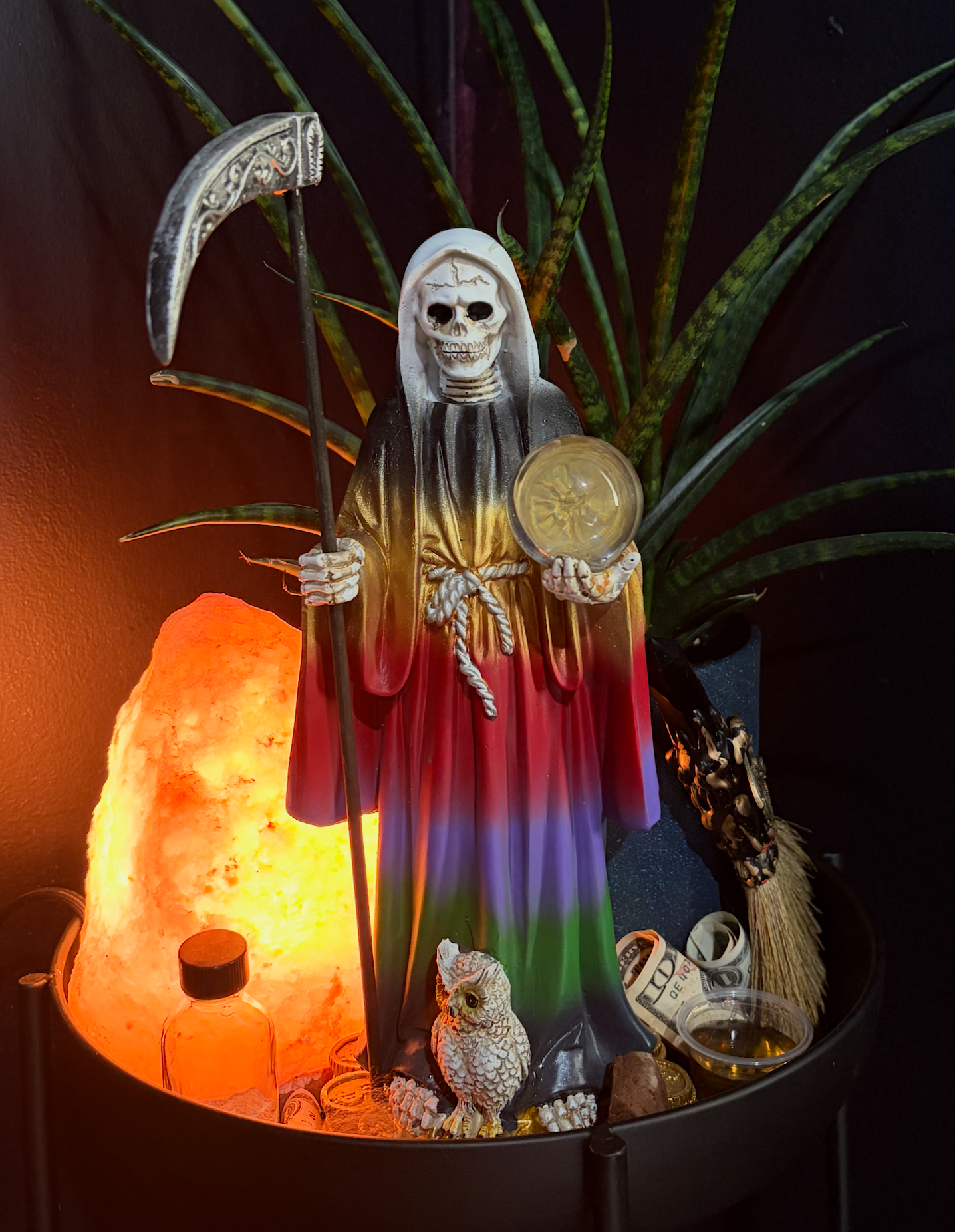
Our Santa Muerte Altar at La Cueva
Santa Muerte, for those who are unfamiliar with her, is a “Neo-religious” folk deity, most followed in Mexico, places with large Mexican American populations (such as Los Angeles), and Central America. She is a controversial and highly misunderstood figure, heavily associated with cartels, with many people believing she is Satanic. The Catholic Church has labeled her following as “blasphemy”, engaging in a serious crackdown on her. As such, she largely remains hidden, with shrines dedicated to her often in secret, or in corners of botanicas, grocery stores, and more.
The reality of Santa Muerte is that she is “the lady of the dead”, a nonjudgmental deity (or saint, if you think so) who does not judge anyone who prays to her, and calls upon her powers. She doesn’t care who you are, and this nonjudgmental perspective has attracted so many Mexican “outcasts”, queers, trans people, “criminals”, sex workers, women challenging the patriarchy, and so on and so forth. For those of us who have felt betrayed or abandoned by the Catholic Church, she has been a source of solace and companionship. And as much as the current Vatican wants to hate on her, it’s funny how much she has in common with La Virgen de Guadalupe, centuries ago. Both of them were seen as “blasphemy” in their time.
Santa Muerte always drew me intellectually. As an activist, the “lore” and “hatred by the authorities” around her fascinated me just as much. As a queer Mexican woman, who always felt abandoned by the Catholic Church (not just for my queerness, but for other reasons), I was fascinated and warmed up by the fact that many like me found solace in her. For those who are unfamiliar with me, I graduated from law school and worked in public defense for about five years. When I thought I wanted to be a lawyer, I thought I would become a public defender. Working in that field was a doozy but also highly informative. Through law school and public defense, I didn’t just develop my own sense of dark humor, but also a clear understanding that the definition of “criminal” wasn’t linear or fully ‘black or white.’ I developed a sharp analysis and understanding that everything is nuanced, and morality is ‘squishy.’ What one culture, person, group, hierarchy, etc defines as ‘moral’ or ‘correct’ could be completely immoral or incorrect with another group. “Crimes” can be caused by environments, mental health issues from family trauma, climate disasters, poverty, wars, or so much more. Very little is actually the “cause of the individual”, but rather, very flawed and fucked up systems. The law is often not “moral.” After all, slavery one time was legal. Engaging in civil disobedience, in defiance of such laws, is seen as “illegal.” Loving who you want to love, still to this day in some parts of the world, is “illegal”. So when I found out that many Mexicans, Mexican Americans/Chicanos, Central Americans, etc found solace in Santa Muerte, I was intrigued.
I am very “Anti-Catholic” but Pro-Spirituality. I’m a Chicana, born of Mexican immigrant former farmworkers. I grew up in a very devoutly Catholic family. I was also married to an African American for four years, and together with him for nearly ten years. He was very much an activist, and shared very similar political views to me. Through that relationship, we were able to mutually share about our frustrations with the religious hierarchy in the country. And individually, I was able to travel to the Deep South and Appalachia to learn from former and current civil rights leaders about activism and organizing. I learned how important Christian Faith was especially to Black and Brown ‘Amerikkka’. I am not one to judge, but merely here to say, that just because I’m ‘anti-religion’ doesn't mean that I will ever hate anyone for following any faith. And as such, I hope that no one judges me.
This brings me back to Santa Muerte. I have a lot of feelings around growing up Catholic, but I will say, my eclectic practice found itself honoring and working with Dark Goddesses. Santa Muerte came to me shortly after Lilith came to me. I heard more about her from a song from the band Twin Temple, but before that had seen imagery and heard about her, and felt such power, resonance, and familiarity with the deity. And when I painted her and began working with her, she helped propel boundaries and cord-cutting that needed to happen. Since then, I’ve ensured that I have a little dedication to her in my home and an altar in my shop, La Cueva.
Working with Santa Muerte has proven to be liberating, healing, and a source of protection for me. It’s also allowed me to work more intentionally and profoundly with spiritual death more easily. I feel such a strong sense of home and safety in many ways in working with Santa Muerte, and feel so compelled to share more about her- not evangelize or try to persuade people to join “my faith” but rather let people know about my connection to her. In honoring her and centering her in a public space such as La Cueva, I feel like I’m occupying a rare space as well in the Pacific Northwest. One where she is publicly acknowledged in a metaphysical shop. I see spiritual spaces from Mexicans, often work with Catholic figures and deities, but it’s so rare to see any for Santa Muerte. I know that I’m not the only one, that there are others like me, so I hope that my shop becomes a beacon for those who not just honor her, but other deities like her.